

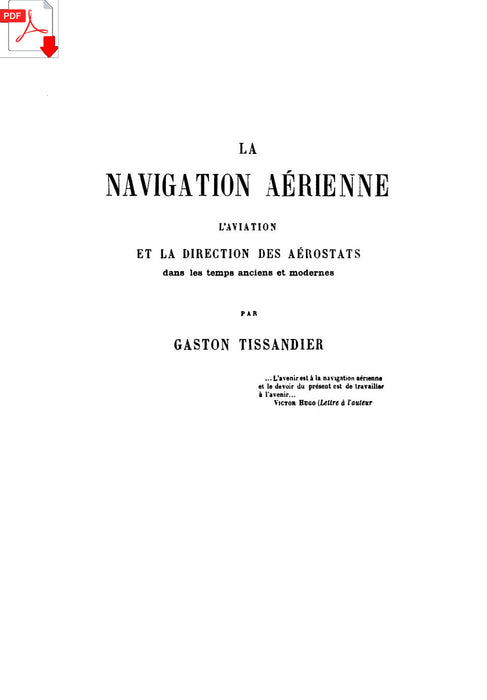


Tissandier, Gaston - La navigation aérienne, l'aviation et la direction des aérostats (1886)(ebook)
• Tous les projets de machines volantes de l’Antiquité aux Montgolfier
· La légendes des hommes volants
· Léonard de Vinci, l’hélicoptère et le parachute
· Les voitures volantes
· L’hydrogène et les aérostats
• La locomotion atmosphérique par les plus lourds que l’air
· Le vol des insectes et des oiseaux
· Projets d’homme volant et d’oiseaux mécaniques
· Cerf-volant, parachute et aéroplane à air comprimé
• Le problème de la direction des ballons
· Premières expérience direction aérienne – le ballon à rames
· Les ballons à voile – Les ballons planeur – Le ballon de cuivre
· La propulsion mécanique des aérostats
· Le ballon-navire – le ballon-poisson – le ballon à vis
• Les navires aériens à hélice
· Les ballons à vapeur et le dirigeable à vapeur
· Premiers dirigeables pendant le siège de Paris
· Le navire aérien à propulsion électrique
· Propulseur à aile, l’hélice et l’avenir de la navigation aérienne
Gaston Tissandier ( 1843 - 1899) est un scientifique et aérostier français. Il fait sa première ascension en 1868 ; elle sera suivie de 44 autres. En 1869, il vole au-dessus du Pôle Nord. Durant le siège de Paris, il est le quatrième à partir dans un ballon. Il propose aux autorités de tenter le retour sur Paris, mais échoue.
Il est nommé capitaine dans un nouveau corps d'aérostation militaire pour l'observation des champs de bataille. En 1875, il bat le record de durée en ballon avec 22 h 40. La même année, il tente de monter au-delà de 7300 mètres d'altitude. Il échappe à la mort, mais perd presque la totalité du sens de l'ouïe.
En 1878, il construit et vole sur un ballon à hydrogène. En 1881, il construit le premier ballon dirigeable mû par l'électricité. En 1885, il décolle d’Auteuil avec un photographe pour réaliser les premières photos aériennes.
322 pages. En français. PDF à télécharger
-------------------
• All flying machine projects from ancient times to the Montgolfier brothers
• Legends of flying men
• Leonardo da Vinci, the helicopter and the parachute
• Flying cars
• Hydrogen and aerostats
• Atmospheric locomotion by heavier-than-air machines
• The flight of insects and birds
• Projects for flying men and mechanical birds
• Kites, parachutes and compressed air aeroplanes
• The problem of steering balloons
• First experiments in aerial steering – the rowing balloon
• Sail balloons – Gliding balloons – The copper balloon
• Mechanical propulsion of aerostats
• The balloon ship – the balloon fish – the screw balloon
• Propeller-driven airships
• Steam balloons and the steam airship
• First airships during the siege of Paris
• The electrically powered airship
• Wing propulsion, the propeller and the future of air navigation
Gaston Tissandier (1843–1899) was a French scientist and aeronaut. He made his first ascent in 1868, followed by 44 others. In 1869, he flew over the North Pole. During the siege of Paris, he was the fourth person to take off in a balloon. He offered to attempt a return flight to Paris, but failed.
He was appointed captain of a new military balloon corps for battlefield observation. In 1875, he broke the record for the longest balloon flight, lasting 22 hours and 40 minutes. That same year, he attempted to climb to an altitude of over 7,300 metres. He escaped death but lost almost all of his hearing.
In 1878, he built and flew a hydrogen balloon. In 1881, he built the first electrically powered dirigible. In 1885, he took off from Auteuil with a photographer to take the first aerial photographs.
322 pages - in French
Digital edition to download
Edition numérique à télécharger
Edizione digitale da scaricare
Digitale Ausgabe zum Herunterladen
Edición digital para descargar
Edição digital para descarregar
Digitale editie om te downloaden
数字版下载
نسخة رقمية للتحميل
デジタル版ダウンロード
디지털 에디션 다운로드