



Goecke Powers, Sheryll - Women in flight research at NASA Dryden (1997) (ebook)
Women in flight research at NASA Dryden Research Center from 1946 to 1995
By Sheryll Goecke Powers
NASA History Office (1997)
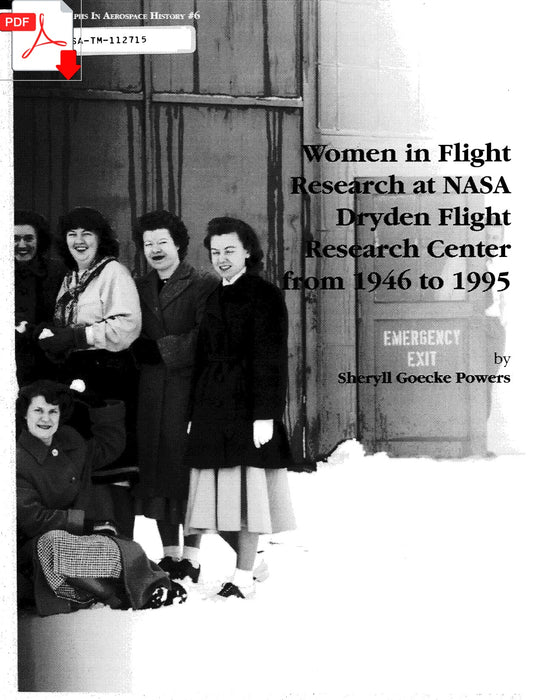
Women have been involved with flight research at NASA Dryden Flight Research Centre since its inception as the site for flight research on advanced, high-speed aircraft. The first research involved transonic aircraft, including the X-1, the first piloted aircraft to exceed the speed of sound (exceed a Mach number of 1.0). The working environment for the women in the engineering field was influenced by several factors. One factor was the growth of Dryden from 13 or 14 employees (2 of them women) at the end of 19461 to the December 1995 size of approximately 450 employees. Other factors include the effect of World War II on the availability of engineers and the advent of digital computers. This monograph describes the working and living environment for the women during the late 1940s and early 1950s. The number of women engineers, their work and the airplanes they worked on from 1960 to December 1995 are also discussed. In order to better understand the labour intensive data gathering and analysis procedures before the age of digital computers, typical instrumentation used on the X-series aircraft from the X-1 through the X-15 is shown.
The changes in the social attitude toward the women engineers, and the other women at Dryden as well, are as dramatic as the changes in engineering task. For example, until the late 1960’s to early 1970’s, women were expected to wear dresses (or skirts) and shoes with heels and hose. Slacks were permissible only for very rare occasions. This unwritten dress code made it more difficult to do tasks that were easy for the men, such as climbing a ladder to examine the pressure orifices on the top surface of a wing. Today, casual slacks and jeans are as acceptable as more formal dress.
Social attitudes restricted non-work activities as well. One woman, who graduated from college in the late 1950s, told me how concern about reputation had adversely affected her non-work activities. She, her boyfriend and another couple who were also dating wanted to go on a camping trip. But, there was no married couple who could act as chaperones. She decided the trip would be too great a risk to her reputation and did not go. She regretted that decision and wished that she had gone camping. The other woman (not a NASA employee) did go. The woman telling me was considered by all to be very staid and proper. I don't know anyone who could have conceived of her doing anything wild and foolish. By the late 1970s to early 1980s, the attitudes had definitely changed. I remember one story about a young woman of that time who worked at NASA for a few years. The story concerned her and her boyfriend who was a skydiver. On this particular dive, he was attempting to hit a marked ground target. To provide added incentive for him, she stripped and lay in the center of the target. I never heard how close he actually came to the target. I don't even know for sure that the story was true. However, because I knew her, I believe the story. Another change in social attitude concerns women working after marriage. During the early years, most women who married when they were working were expected to quit their jobs soon after, and most did. That isn't true today.
86 pages – PDF to download